Commercial Soft Washing: Gentle, Effective Exterior Cleaning for Businesses

Commercial soft washing uses low-pressure spray systems combined with biodegradable, purpose-made cleaning solutions to remove algae, mold, mildew, and other stains without harming building materials. This guide explains how soft washing protects assets, boosts curb appeal, and supports environmental compliance for facility managers and property owners. You’ll get a clear, step-by-step look at the soft-wash process, techniques tailored to roofs, siding and concrete, plus eco-friendly product options, runoff controls, and practical vendor selection criteria for commercial projects. We also compare soft wash with pressure wash, tally the top business benefits, and include decision checklists and reference tables to speed procurement. Throughout, we emphasize measurable outcomes, maintenance ROI, and local operational considerations relevant to commercial properties and facilities teams.
What Is Commercial Soft Washing and How Does It Differ from Pressure Washing?
Commercial soft washing is the low-pressure application of specialty cleaning agents designed to chemically remove biological contaminants—algae, mold, mildew—so surfaces are restored without mechanical damage. The process depends on surfactants, detergents, and oxidizers to break down microbial root structures while avoiding the abrasion and erosion that high-pressure water can cause. For businesses, that means effective, longer-lasting removal with less risk to roofs, siding, signs, and glazing. Knowing how each method works helps facility teams pick the approach that best protects assets and meets warranty or regulatory requirements.
How Does Soft Washing Work for Commercial Exterior Surfaces?
Soft washing starts with an on-site inspection and pre-protection plan to identify sensitive equipment, landscaping, and runoff paths. Technicians apply diluted cleaning solutions with calibrated low-pressure pumps and injection systems, allow an appropriate dwell time for the chemistry to work, then rinse or lightly agitate where safe. Crews use low-impact nozzles, access equipment for larger sites, PPE, and containment tools to manage runoff and safety. A final inspection documents results and, when appropriate, technicians apply protectants or coatings. The workflow reduces water use and abrasion while maximizing biological removal and longer-term cleanliness.
What Are the Key Differences Between Soft Wash and Pressure Wash for Businesses?
The core differences are pressure, cleaning mechanism, and material compatibility. Soft washing relies on chemical action at low pressure to eliminate organic growth; pressure washing uses force that can strip coatings, remove shingle granules, or erode mortar. For delicate surfaces and biological removal, soft wash lowers the chance of accidental damage and can extend asset life. Pressure washing still plays a role for heavy soiling or concrete degreasing, but it typically requires greater containment for runoff and can shorten material lifespans if used improperly. Choose based on substrate, desired outcome, warranty terms, and environmental controls.
What Are the Top Benefits of Soft Washing for Commercial Properties?
Soft washing delivers measurable benefits: it preserves building materials, improves curb appeal, and cuts reactive repair costs by removing organic growth at the root. Eliminating algae and mold reduces moisture retention and slows material degradation, which can extend the service life of roofs, facades, and hardscapes and reduce replacement frequency. Clean exteriors also improve tenant and customer perception, while safer, non-slip surfaces lower liability risks. For facility managers, the result is predictable maintenance intervals, simpler budgeting, and a clear ROI from avoided repairs and replacements.
Different commercial surfaces enjoy specific advantages from regular soft washing:
| Surface Type | Primary Benefit | Business Impact |
|---|---|---|
| Roofs | Longer life thanks to biological removal | Fewer premature replacements; lower capital expense |
| Siding & Facades | Preserves paint and finishes | Reduced repainting and restoration cycles |
| Concrete & Walkways | Removes contaminants and reduces slip risk | Fewer incident claims; safer tenant/customer access |
- Financial: reduced long-term repair and replacement costs for critical exterior assets.
- Operational: predictable maintenance schedules that simplify facility budgeting and procurement.
- Reputational: improved curb appeal that supports tenant retention and positive customer impressions.
Viewed as a planned maintenance activity—not a one-off fix—soft washing becomes a cost-effective way to protect assets. For organizations that want consistent, documented results, certified commercial providers with repeatable processes simplify planning and execution. Veteran’s Cleaning Solutions, a Service-Disabled Veteran-Owned Small Business certified by SoftWash Systems and serving Southeast Alabama, uses a four-step customer process—Call Up, Meet Up, Clean Up, Follow Up—to align soft washing with commercial maintenance KPIs and provide consistent documentation.
How Does Soft Washing Prevent Damage and Extend Surface Life?
Soft washing prevents damage by removing biological growth chemically rather than mechanically, which preserves coatings, shingle granules, and masonry joints. Algae and mold form root-like structures that trap moisture and accelerate material breakdown; eliminating those colonies reduces moisture retention and slows deterioration. For facility teams that translates into fewer emergency repairs and longer intervals between major restorations—figures you can include in lifecycle cost models. Maintenance intervals depend on climate and exposure; pairing scheduled soft washing with inspections optimizes preservation and budgeting.
How Does Soft Washing Improve Curb Appeal and Property Value?
Removing stains, streaks, and grime restores a uniform look to roofs, facades, and hardscapes, producing immediate curb appeal gains that affect tenant attraction and customer confidence. Clean exteriors signal proactive property management and attention to safety—factors that can strengthen lease negotiations and support higher occupancy. While exact valuation effects vary, steady exterior upkeep improves marketability and reduces vacancy-related costs. Sharing before-and-after photos and a maintenance plan with stakeholders helps translate cleaning investments into clear operational and financial benefits.
Which Soft Washing Techniques Are Best for Commercial Roofs, Siding, and Concrete?
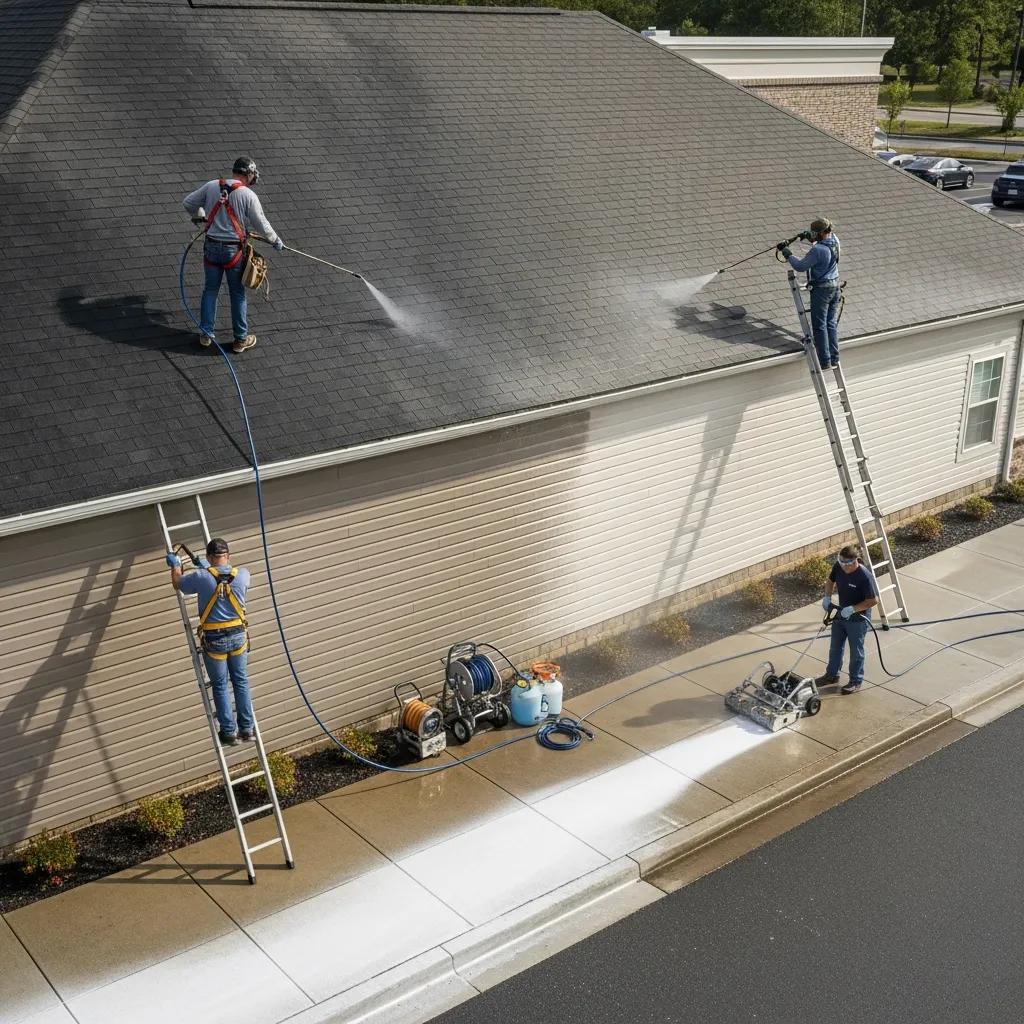
Effective techniques match chemical concentration, dwell time, agitation, and rinsing strategy to each surface so you protect materials and comply with warranties. On roofs, low-volume applications with longer dwell times let surfactants and biocides work without disturbing shingles. For siding, gentle application and targeted soft brushing remove dirt without lifting paint. On concrete, pre-treatment and spot agitation lift oil and rust before a low-pressure rinse. Safety planning—scaffolding, fall protection, and traffic control—is part of the technique selection for commercial-scale sites.
| Surface | Technique | Recommended Parameters |
|---|---|---|
| Asphalt shingle roofs | Low-pressure application with surfactant + oxidizer | Dwell 10–20 minutes; rinse gently; avoid scrubbing |
| Vinyl/stucco siding | Low-pressure coat and soft brush agitation as needed | Follow product dilution; short dwell 5–15 minutes; rinse downward |
| Concrete/hardscape | Pre-treat with degreaser and agitate prior to rinse | Pre-treat 5–10 minutes; mechanical agitation for stains; higher-volume rinse |
What Are the Best Practices for Soft Washing Commercial Roofs?
Start with a thorough inspection to confirm roof material, warranty limits, and equipment sensitivity. Select chemicals that match the substrate and use calibrated injectors, low-pressure pumps, and soft nozzles. Apply surfactant/biocide blends at manufacturer-recommended dilutions and dwell times, protect landscaping and solar arrays, and use containment where needed. Document product names, concentrations, photos, and procedures to support warranties and compliance. Regularly scheduled soft washing plus inspections produces measurable lifespan improvements and fewer emergency repairs.
How Is Soft Washing Applied to Commercial Siding and Concrete Surfaces?
For siding, pick concentrations and application methods by material—vinyl tolerates different detergents than stucco or brick—and finish with a gentle rinse to avoid washback behind cladding. Concrete and hardscape cleaning often starts with a degreaser and spot agitation for oil, gum, or rust; only use aggressive pressure on concrete when the substrate is known to tolerate it. Combining soft wash chemistry with selective mechanical work delivers thorough cleaning while minimizing material wear and extending surface life.
How Do Eco-Friendly Soft Washing Solutions Benefit Commercial Exterior Cleaning?

Eco-friendly soft washing formulas—biodegradable surfactants, oxygen-based oxidizers, and low-toxicity detergents—control organic growth while supporting environmental and corporate sustainability goals. These chemistries reduce ecological risk in runoff and, when paired with containment and neutralization, simplify permitting and stakeholder communication. For facility managers, the sustainability wins also reduce regulatory friction and support corporate responsibility reporting. Choosing the right agent and combining it with runoff management and recordkeeping delivers both cleaning performance and compliance confidence.
Characterizing Commercial Detergents and Their Environmental Impact
Many commercial detergents are formulated to dissolve grease and dirt and then carried away in wash water. If those active ingredients don’t biodegrade, they can harm aquatic ecosystems after entering sewage or waterways. That environmental risk has driven research comparing conventional detergents with more biodegradable, natural alternatives.
Below is a comparison of common biodegradable agent categories used in commercial soft washing, with environmental notes and compliance flags for facility teams.
| Agent Type | Typical Use | Environmental / Compliance Note |
|---|---|---|
| Alkaline surfactants | General biological and dirt removal | Generally biodegradable; monitor pH neutralization for runoff |
| Oxygen-based oxidizers (peroxide) | Stain and organic breakdown | Breaks down to water and oxygen; low environmental persistence |
| Low-toxicity chelators | Metal stain and deposit management | Use sparingly; verify local discharge rules for chelated compounds |
- Containment: use downstream controls and absorbents to limit runoff impacts.
- Dilution control: apply the minimal effective concentration to lower environmental load.
- Documentation: keep product data, application rates, and neutralization records for audits.
Following these steps supports regulatory compliance and corporate sustainability reporting while keeping cleaning standards high.
What Biodegradable Cleaning Agents Are Used in Commercial Soft Washing?
Typical biodegradable agents include non-ionic surfactants for wetting and dirt removal, oxygen-based oxidizers (peroxide) for organic breakdown, and low-toxicity chelators for metal stains. Each has trade-offs: surfactants clean well but require pH management; oxidizers break organics quickly and leave little residue; chelators solve specific stains but need careful disposal consideration. Commercial teams generally use manufacturer-labeled biodegradable products and keep SDSs in a compliance binder to meet local discharge rules and sustainability targets.
How Does Soft Washing Promote Sustainability and Environmental Compliance?
Soft washing supports sustainability by using less water, targeted application, and biodegradable chemistries—reducing resource use versus repeated high-pressure re-sprays or costly restorative repairs. Compliance steps include containment planning before work, pH neutralization of runoff when required, waste capture for concentrated residues, and maintaining application logs that document products and discharge controls. Facility managers can fold these records into environmental reporting and vendor contracts to ensure accountability. Regular audits and updated crew training reinforce compliant, sustainable practices.
How to Choose the Right Commercial Soft Washing Provider for Your Business?
Choose a provider with verifiable certifications, insurance, commercial references, environmental controls, and local experience with your asset types and regulations. Ask for SoftWash Systems certification, current liability and workers’ compensation insurance, evidence of similar commercial jobs, and written runoff/containment procedures. Request site-specific proposals that include SDS sheets, dilution rates, dwell times, access and safety plans, and a commitment to recordkeeping for audits. A consistent checklist helps standardize vendor evaluation and lowers procurement risk.
- Request verifiable certifications and SDS documentation.
- Confirm commercial insurance and documented safety programs for crews.
- Ask for references and measurable outcomes from similar property types.
- Verify runoff management, neutralization, and recordkeeping practices.
What Certifications and Experience Should You Look for in a Soft Washing Company?
Look for SoftWash Systems certification, proof of commercial insurance and bonding, documented safety training, and verifiable commercial project references with before/after photos. Ask for sample work plans showing chemical concentrations, dwell times, and environmental controls so you can compare methods—not just price. Red flags include refusal to provide SDSs, no references, or unclear containment plans. A vendor that provides site-specific proposals, clear documentation, and solid safety protocols reduces operational risk and supports procurement approvals.
Why Is Veteran’s Cleaning Solutions a Trusted Choice for Commercial Soft Washing in Southeast Alabama?
Veteran’s Cleaning Solutions is a Service-Disabled Veteran-Owned Small Business serving Southeast Alabama. We hold SoftWash Systems certification, carry commercial insurance, and follow a documented four-step customer process—Call Up, Meet Up, Clean Up, Follow Up. Our approach emphasizes transparent proposals, documented chemical use, and practical maintenance planning. We also offer a free guide, “How to Avoid Nightmare Cleaners,” to help facility managers vet vendors. For regional organizations seeking a local, certified provider with repeatable processes, requesting a consultation or the guide is a practical next step toward compliant, documented soft-wash maintenance.
What Are Real Commercial Soft Washing Success Stories and Case Studies?
Successful commercial soft washing projects show measurable results: fewer premature roof replacements, longer repaint cycles, sharper storefront presentation, and documented reductions in slip-and-fall hazards. Local case summaries give decision-makers conservative maintenance-saving estimates and visual proof to support budget approvals. Providing project photos, material condition notes, and concise ROI metrics strengthens procurement cases and helps facilities benchmark expected results.
How Have Businesses Benefited from Soft Washing in Southeast Alabama?
Local projects have restored storefront facades for better curb appeal, treated roofs to remove damaging algae and stabilize shingle conditions, and cleaned walkways to cut slip risks during wet months. Photo documentation and maintenance logs show measurable reductions in emergency repairs and improved tenant perception. If you want comparable outcomes, request a site assessment for a tailored scope, projected maintenance interval, and conservative lifecycle-savings estimate based on local conditions.
What Do Clients Say About Their Commercial Soft Washing Results?
Clients consistently praise punctual crews, clear documentation, and minimal disruption during commercial cleanings. They value vendors who share pre-protection plans and post-service records. Aggregated feedback supports scheduled soft washing as a cost-effective maintenance strategy that preserves asset value and appearance. For procurement teams, ask for full case studies and references, and schedule a site visit to review documented outcomes and projected maintenance savings.
- Request full case studies for comparable properties to validate expected results.
- Ask for site-specific ROI estimates tied to maintenance schedules and avoided replacement costs.
- Schedule a site visit to receive a tailored proposal and documented cleaning plan.
Taking these steps turns case-study evidence into actionable procurement decisions and ensures the cleaning scope aligns with operational goals.
Frequently Asked Questions
What types of surfaces can benefit from commercial soft washing?
Soft washing is effective on roofs, siding, concrete, and other hardscapes. Each surface needs specific techniques and agents—e.g., asphalt shingles require low-pressure application to avoid granule loss, vinyl siding accepts certain detergents, and concrete often needs a degreaser first. Matching method to material gives the best, safest results.
How often should commercial properties undergo soft washing?
Frequency depends on climate, location, and surface type. A common range is every 6 to 12 months, with more frequent service in humid or high-pollen areas. Regular inspections help set the right interval so surfaces stay protected and costly repairs are avoided.
Are there any risks associated with soft washing?
Soft washing is safe when done correctly, but risks include improper chemical use or poor runoff management. Using the wrong concentration or ignoring containment can damage surfaces or nearby landscaping. Working with certified professionals who document products and runoff controls minimizes those risks.
What should businesses look for in a soft washing contract?
A good contract spells out the cleaning process, chemicals used, application methods, safety measures, service frequency, documentation, and any guarantees. Confirm the provider carries liability insurance and appropriate certifications. Clear contracts protect both parties and set expectations.
Can soft washing help with mold and mildew issues?
Yes. Soft washing uses biodegradable detergents and biocides that penetrate and remove mold and mildew at the root, reducing regrowth. It’s gentler on surfaces than high-pressure washing and is an effective part of a mold-control program.
How can businesses ensure compliance with environmental regulations during soft washing?
Choose providers that use eco-friendly agents and proven runoff controls—containment, neutralization, and waste capture. Keep detailed records of products and application methods to support audits. Working with certified pros who know local rules is key to minimizing environmental impact.
Conclusion
Commercial soft washing is a practical, asset-preserving maintenance strategy that enhances curb appeal and reduces long-term repair costs. When paired with biodegradable products, proper containment, and documented procedures, it also supports environmental compliance and sustainability goals. Choosing a certified provider like Veteran’s Cleaning Solutions can simplify planning and deliver measurable results—start with a consultation to build a site-specific maintenance plan and protect your commercial assets.
